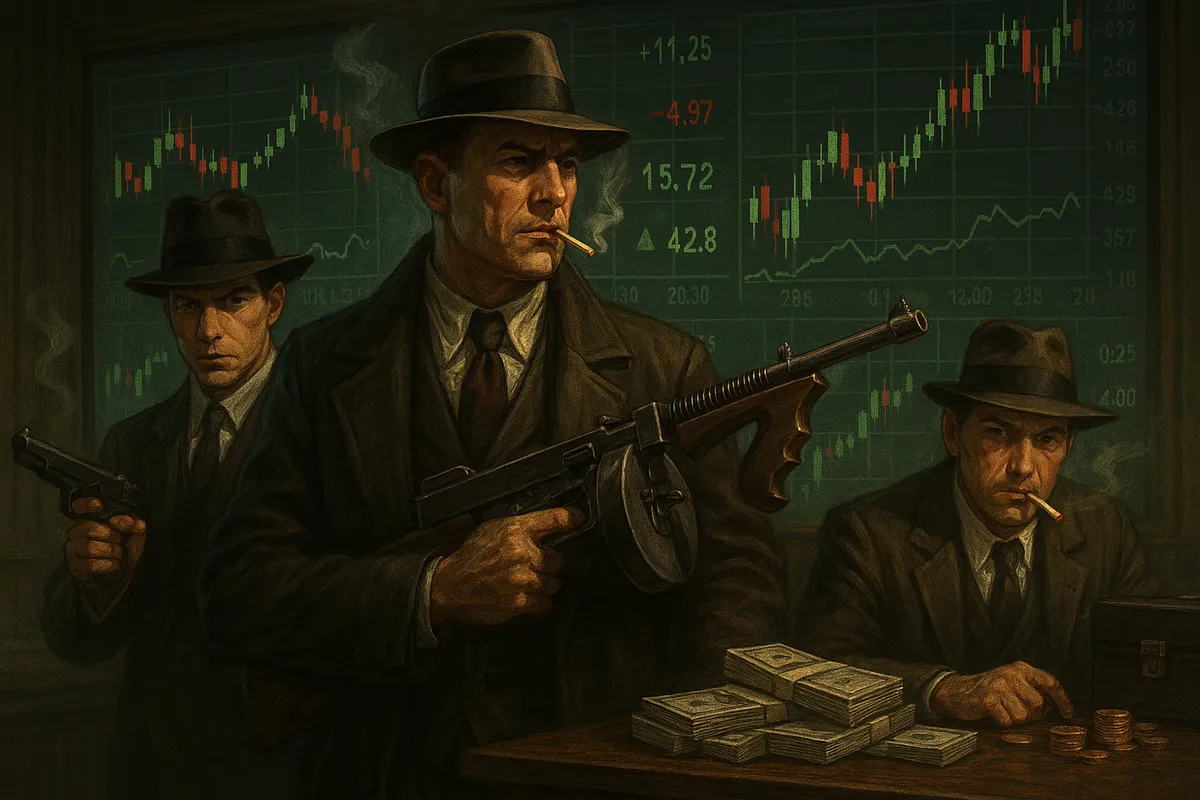
The stock exchange is where MafiaKill's wealthiest players diversify. Beyond crimes and businesses, you can buy shares in eight fictional companies, collect dividends, and ride a market that is simulated in real time — prices tick every thirty minutes, driven by industry volatility, trading volume and a daily cycle.
Unlike the black market's player-to-player deals, the exchange is a clean, regulated way to park money that also grows it. You pay a trading fee, a level-based cap limits how much of one company you can hold, and every share you own pays a dividend. This guide covers the full board, the fee structure, and how the market actually moves.
What the Stock Exchange Is
The exchange lists eight companies, each with its own ticker, share price, dividend and price-to-earnings ratio. The market screen splits into three tabs: the market itself where you buy, your portfolio where you track value and gains, and a transaction history that records every trade you make.
Buying is done directly from the market board. Each company shows how many shares are available and what they cost, and you can expand a company row to place a buy order. Selling is handled from your portfolio, which recalculates your total value, your percentage gain or loss and your overall position against what you invested.
The Eight Listed Companies
The board covers every corner of the criminal economy, from ammo manufacturers to casino entertainment. Prices range from the budget Pharmafirma at just over $45 to the heavyweight offshore bank at nearly $235 a share. Dividend-paying companies reward long-term holders, while low-dividend growth stocks rely on price movement.
Casino Entertainment trades at the richest dividend of the eight, while Car Theft Syndicate pays none at all and is purely a price-play. If you prefer income over speculation, watch the dividend column; if you like volatility, look at the P/E ratios.
| Ticker | Company | Price | Dividend | P/E |
|---|---|---|---|---|
| MAFI | Mafia Holdings Inc | $125.50 | 2.5 | 18.5 |
| BULX | Bullet Express | $89.25 | 2.5 | — |
| CARX | Car Theft Syndicate | $67.80 | 0 | 22.1 |
| DRUG | Pharma | $45.60 | 3.2 | 12.8 |
| CASX | Casino Entertainment | $156.30 | 4.1 | 25.3 |
| SHIP | Shipping | $78.90 | 2.1 | 16.7 |
| BANK | Offshore Finance | $234.75 | 3.8 | 19.2 |
| TECH | Cyber Security | $189.40 | 1.2 | 28.5 |
Selling Your Portfolio
Selling returns your shares to the market's available pool and credits the proceeds, minus the same 1% fee, straight to your cash. Your portfolio shows you exactly where you stand: current value, total invested and the overall gain or loss percentage across your whole position.
There is no need to micromanage individual lot sizes — a 'Sell All' action clears a company position with a confirmation step, which is the fastest way to exit a stock you believe is about to drop. Between the buy fee, the sell fee and the cooldown, the exchange rewards patience and punishes churn.
Pro Tips
- Use Sell All to exit a falling stock in one click.
- Remember both fees when calculating your real profit margin.
- Reinvest dividends instead of cashing them out to compound faster.
How the Market Moves
The simulated market updates every thirty minutes, and a full trading day resets at 17:00 — previous close, day high, day low and volume all roll over so each day starts clean. Between updates, the price history chart builds up a real record you can read.
Each industry has its own volatility, which is what makes some stocks swing harder than others. Automotive theft is the most volatile sector and transportation the calmest, with volatility ranging from 0.8% to 2% per tick. Trading hours matter too: during the 9:00 to 16:00 window the market's activity factor rises to 1.1, and outside it falls to 0.9, so prices move faster mid-day.
Supply is dynamic as well — every tick generates new volume equal to a fraction of a company's available shares, which is why prices drift even without big buyers. The result is a living market with trends, spread and momentum, not a static price list.
Pro Tips
- Volatile sectors (like car theft) are where big swings — and big wins — happen.
- Trade during the 9–16 window when the market is most active.
- Watch the daily 17:00 reset; early trades set the day's tone.
Pro Tips
- 1.Fees are 1% or $100 minimum on both sides — size your trades.
- 2.Max holding is level × 300 shares per company.
- 3.Dividends reward long-term holders over day traders.
- 4.The market ticks every 30 minutes; check in, don't live in it.
- 5.Keep cash on hand for trades — your portfolio can't save you from a jam.
- 6.New players usually burn money chasing the most volatile tickers — hold at least half your portfolio in dividend payers like Casino Entertainment until you have a feel for the 30-minute cycle.
Frequently Asked Questions
What fees does the stock exchange charge?
How many shares can I hold in one company?
When does the stock market update?
Can I buy and sell stocks while in jail?
Related Pages
The bank guide in MafiaKill — depositing and withdrawing cash, the 5% annual interest rate, player transfers, the 10% gang donation fee, and why a full bank account beats a full wallet.
The black market guide — buying and selling cars, weapons and goods with other players, the player-driven economy, and how to trade like a professional.
The MafiaKill item shop — timed full protection, the hiding (disappear) system, weapon power-ups, gangster recruits for your crew, and credits packages.
The properties guide for MafiaKill — the Abandoned Warehouse, Strip Club, Hotel and Casino, the mafia items you need to claim them, income multipliers, and the 10-hour upgrade cycle.
Ready to rule the streets?
Join MafiaKill for free and start building your criminal empire today. No download required.
Play Free Now